Qooper vs. Consilairi
People land on this comparison because both products sit under “career growth.” That’s where the similarity ends.
- Qooper is built for HR / L&D / Talent teams to run structured mentoring + learning programs at scale, with admin tooling, integrations, and reporting.
- Consiliari.ai is built for individual professionals to manage their career with an AI coach + a scoring system (COS) and a set of planning/optimization tools, with transparent self-serve pricing.
If you’re choosing between them, you’re usually choosing between two different operating models:
- “My company wants to run mentorship across employees.” → Qooper
- “I personally want an always-on career strategy system.” → Consiliari
What Qooper actually is (and who it’s for)
Qooper positions itself as an online mentoring (and broader learning) platform designed to make mentoring programs “easy & impactful,” and to help organizations improve people metrics like retention, onboarding, performance, and succession.
Core platform capabilities (from Qooper + third-party summaries)
Across its own site and major software directories, Qooper is consistently described as offering:
- Mentor/mentee matching (including “smart” matching)
- Guidance/training content for mentoring relationships
- Conversation guidance and program structure
- Tracking + reporting
- Enterprise integrations and admin controls
Qooper also markets an ROI/people-metrics dashboard tied to mentoring and learning program impact.
Use cases Qooper explicitly targets
Qooper’s own use-case navigation calls out things like org-wide career mentoring, onboarding/training, leadership development, ERGs/communities, and student/alumni mentoring.
Qooper’s AI layer
Qooper markets multiple AI capabilities, including:
- AI-assisted mentor matching (analyzing goals/interests/experience)
- A “trainer” style chatbot for mentoring guidance
- AI-created guidance/notetaking experiences
- “AI mentors” concept positioned for mentor scarcity
- “Unified HR/L&D/Talent insights” framing
Integrations matter a lot in Qooper’s model
Qooper’s integrations page explicitly calls out categories like:
- Video + “two-directional calendar” integrations
- Email + SSO
- Teams/Slack/Webex experiences
- HRIS/database sync
- LMS/PMS connections
- Survey-tool embedding/templates
That list tells you the real story: Qooper is designed to plug into company systems and run as a program platform.
What third-party reviews repeatedly emphasize
Capterra review excerpts commonly highlight straightforward usability and a “has what you need” approach for mentors/mentees and administrators.
On G2, Qooper is summarized around smart matching, training, conversation guidance, tracking/reporting, integrations, and support.
In G2’s Mentoring category pages, Qooper appears as a notable product in the category (including “Highest Performer” callouts on category listings).
What Consiliari.ai actually is (and who it’s for)
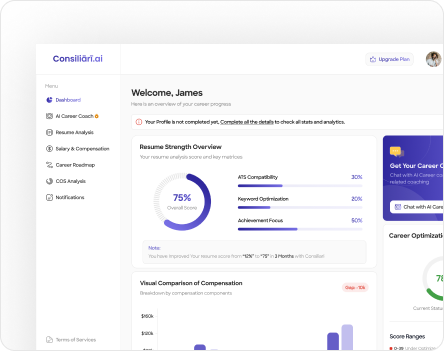
Consiliari positions itself around “career intelligence” and AI-powered coaching for ambitious professionals, explicitly framing the platform as combining AI with career coaching expertise.
The centerpiece: Career Optimization Score (COS)
Consiliari publicly frames COS as an AI metric that translates a professional’s skills/experience/market fit into a clear score with recommended steps to improve it (as described in a distributed press release).
Even if you ignore the press-release framing, the product’s visible content and positioning are built around:
- Measuring career position (a score / readiness concept)
- Creating an action plan to improve outcomes
- Ongoing coaching rather than one-off resume tweaks
Consiliari’s “category stance” (how it differentiates)
Consiliari has published comparisons that make its worldview explicit:
- It positions many job-search tools as “get past the system,” while Consiliari positions itself as “become the person the system can’t ignore.”
- It frames “career AI tools” as split between high-volume application tooling vs outcome-quality tooling.
Those are self-published comparisons, but they’re useful because they reveal the product’s intended job-to-be-done: career strategy + leverage, not just job-application throughput.
Pricing and “product shape”
Consiliari presents self-serve pricing (including a free tier and a paid plan) and explicitly markets “No Ads / No Trackers” messaging on its pricing page.
This points to a different business model than enterprise mentoring platforms: direct relationship with the individual user rather than “HR buys, employees use.”
Third-party footprint (what exists publicly)
Consiliari’s most visible third-party coverage is currently press-release distribution (which is not the same thing as independent reviews).
It also appears in external tracking/aggregation referencing a Product Hunt product URL.
If you want “validated in-market enterprise software” signals like deep G2/Capterra review volume, Qooper has that footprint; Consiliari’s public footprint (based on readily available sources) is more early-stage and content-led.
Side-by-side: what’s actually different
1) Buyer and user are not the same
- Qooper: HR/Talent/L&D buys it; employees participate; admins care about program design, adoption, and measurement.
- Consiliari: the individual professional is the buyer/user (and the product is built around personal career optimization).
2) “Guidance engine” is fundamentally different
- Qooper: guidance comes from human mentors (with software scaffolding + AI assist).
- Consiliari: guidance comes from an AI coach + a scoring/planning system.
3) Measurement and reporting orientation
- Qooper: explicitly ties mentorship programs to measurable “people metrics” and promotes dashboards/analytics.
- Consiliari: measurement is framed as personal (COS and improvement actions) rather than HR program ROI.
4) Integration depth
- Qooper: explicitly markets deep integration categories (SSO, HRIS, LMS/PMS, surveys, Teams/Slack/Webex, calendars).
- Consiliari: the public positioning is consumer-style self-serve; anything beyond that would need to be verified directly from Consiliari’s own pages/contracts (not assumed).
Decision framework: which one should you choose?
Choose Qooper if you are an organization and you need:
- A platform to launch/run mentoring programs across cohorts (onboarding, leadership, ERGs, student/alumni, etc.).
- Admin control + integrations to make programs operationally feasible (SSO/HRIS/calendar/surveys).
- Reporting/analytics to prove participation and outcomes.
- A product with a visible B2B software review footprint (G2/Capterra/GetApp).
Hard truth: if you don’t have enough mentors, enough participant time, and an owner who drives adoption, buying Qooper won’t magically create a mentoring culture. Qooper is clearly thinking about this problem (it’s why it’s pitching AI mentors / trainer bots), but it’s still a leadership and operations problem first.
Choose Consiliari if you are an individual professional and you need:
- A system to quantify where you stand (COS concept) and drive targeted improvement.
- An always-on AI coach style experience designed for personal career decisions, not internal HR programs.
- A self-serve product with transparent positioning around privacy (e.g., “No ads / no trackers”).
Hard truth: if you want an enterprise-grade mentoring program with HRIS/SSO/reporting and admin tooling, Consiliari isn’t positioning itself as that kind of product in its public content. It’s targeting personal career leverage.
Use both when the setup is real
A common “both” scenario is:
- Company uses Qooper to run internal mentoring programs
- Individual employees use Consiliari privately for personal strategy, planning, and negotiation prep
That can work—as long as you’re clear about data boundaries and you don’t mix employer program data with personal tooling without explicit policy/consent.
Security and compliance: what can be stated from public sources
Qooper publicly markets itself as “enterprise ready” and highlights SSO and other enterprise integration patterns.
For Microsoft Teams ecosystem buyers, Qooper’s app listing provides a structured view of compliance attestations (worth checking against your requirements).
Consiliari’s public-facing pricing page emphasizes privacy-forward messaging (“No Ads / No Trackers”) but public sources here don’t provide the same kind of standardized enterprise compliance listing that you typically see for HR platforms.
If compliance is a gating factor for you (SOC 2 scope, DPAs, data residency, etc.), treat marketing claims as insufficient and request the actual documentation in procurement.
The blunt takeaway
- Qooper is a company-program platform. It wins when your goal is structured mentoring at scale with integrations and reporting.
- Consiliari is a personal career intelligence platform. It wins when your goal is continuous career optimization driven by an AI coach and a measurable score.
They’re not direct substitutes. They’re answers to two different questions.
Qooper (official)
https://www.qooper.io/
https://www.qooper.io/mentoring-software
https://www.qooper.io/qooper-ai
https://www.qooper.io/integrations
https://www.qooper.io/reporting-analytics
Qooper (third-party reviews / listings)
https://www.g2.com/products/qooper/reviews
https://www.g2.com/sellers/qooper
https://www.g2.com/categories/mentoring
https://www.getapp.com/hr-employee-management-software/a/qooper/
https://www.capterra.com/p/180286/Qooper/
https://www.capterra.com/p/180286/Qooper/reviews/
Microsoft ecosystem / compliance-style listing
https://marketplace.microsoft.com/en-us/product/office/wa200002964?tab=overview
https://learn.microsoft.com/en-us/microsoft-365-app-certification/teams/cognata-technologies-llc-qooper
Consiliari (official)
https://consiliari.ai/
https://consiliari.ai/about-us/
https://consiliari.ai/career-coaching-pricing/
https://consiliari.ai/jobscan-vs-consiliari/
https://consiliari.ai/aiapply-vs-consiliari-ai/
https://consiliari.ai/product-updates/
Consiliari (third-party coverage / aggregation)
https://www.einpresswire.com/article/845330144/consiliari-launches-the-career-optimization-score-cos-an-ai-metric-that-quantifies-professional-value-and-trajectory
https://crunch.id/producthunt-launch-domain-usage-5th-august-2025/