Executive Coach vs. Career Coach: Stop Wasting Your Money on the Wrong One
Most professionals are playing the game with the wrong rulebook. They hire a career coach when the real problem is their lack of executive presence, or they bring in a high-priced executive coach to polish their resume. The result is a frustrating and expensive waste of time. Both types of coaching can be profoundly valuable, but only when they are applied to the right problem. If you don’t understand the fundamental difference between them, you’re not just leaving money on the table—you’re sabotaging your own potential.
This isn’t about semantics. It’s about strategy. The right coach at the right time can be a career accelerant. The wrong one is a dead end. Let’s cut through the noise and get to the heart of the matter.
The Shared Foundation: A Flawed Premise
Every coaching conversation starts from the same place: a structured partnership designed to provoke thought and drive action. The International Coaching Federation (ICF), the industry’s leading credentialing body, defines coaching as a “thought-provoking and creative process” that helps clients maximize their potential. But that’s where the similarities end. While both executive and career coaches operate under this broad umbrella, their objectives, methodologies, and metrics for success are worlds apart.
What an Executive Coach Actually Does: Navigating the Corridors of Power
An executive coach is a political strategist, a behavioral scientist, and a confidential sounding board, all rolled into one. They work with leaders to enhance their effectiveness within the complex ecosystem of an organization. This is not about finding a new job; it’s about mastering the one you have. The focus is on the subtle and often unspoken rules of power, influence, and perception.
As the Association for Talent Development (ATD) puts it, executive coaching is a “close and confidential relationship” that helps a senior leader grow. It’s about how you show up, how you’re perceived, and how you move the levers of power to get things done.
Think of it as the art of leadership under a microscope.
The work is almost always sponsored by the company, and for good reason. The ROI is staggering. A landmark study by MetrixGlobal found that executive coaching yields a 788% return on investment, driven by increases in productivity and employee retention. This isn’t a perk; it’s a strategic investment in leadership capital.
| Common Executive Coaching Engagements |
| Cultivating Executive Presence and Gravitas |
| Navigating Boardroom and Stakeholder Politics |
| Leading Through Mergers, Acquisitions, and Crises |
| Improving Strategic Decision-Making Under Pressure |
| Eradicating “Derailer” Behaviors (e.g., arrogance, indecision) |
What a Career Coach Actually Does: Hacking the Job Market
A career coach is your personal market intelligence analyst and campaign manager. Their focus is external: the job market. They help you define your value proposition, package it for maximum impact, and execute a targeted campaign to land your next role. This is about career transitions, not in-role performance.
According to the ATD, career coaching helps individuals make decisions and map a path that aligns with their values and interests. It’s a tactical, project-based engagement with a clear and measurable outcome: a better job, a higher salary, or a successful pivot.
This is the science of the job search.
The individual almost always foots the bill, and the pricing reflects the more transactional nature of the work. While the US career coaching market is a substantial $16.9 billion industry , the cost per engagement is significantly lower than for executive coaching, often ranging from a few hundred to a few thousand dollars.
| Common Career Coaching Engagements |
| Achieving Career Clarity and Defining Your Next Move |
| Crafting a Killer Resume and LinkedIn Profile |
| Building a Networking Strategy That Gets You in the Door |
| Mastering the Art of the Interview and a Compelling Narrative |
| Negotiating a Compensation Package That Reflects Your True Value |
The Critical Differences: A Strategic Framework
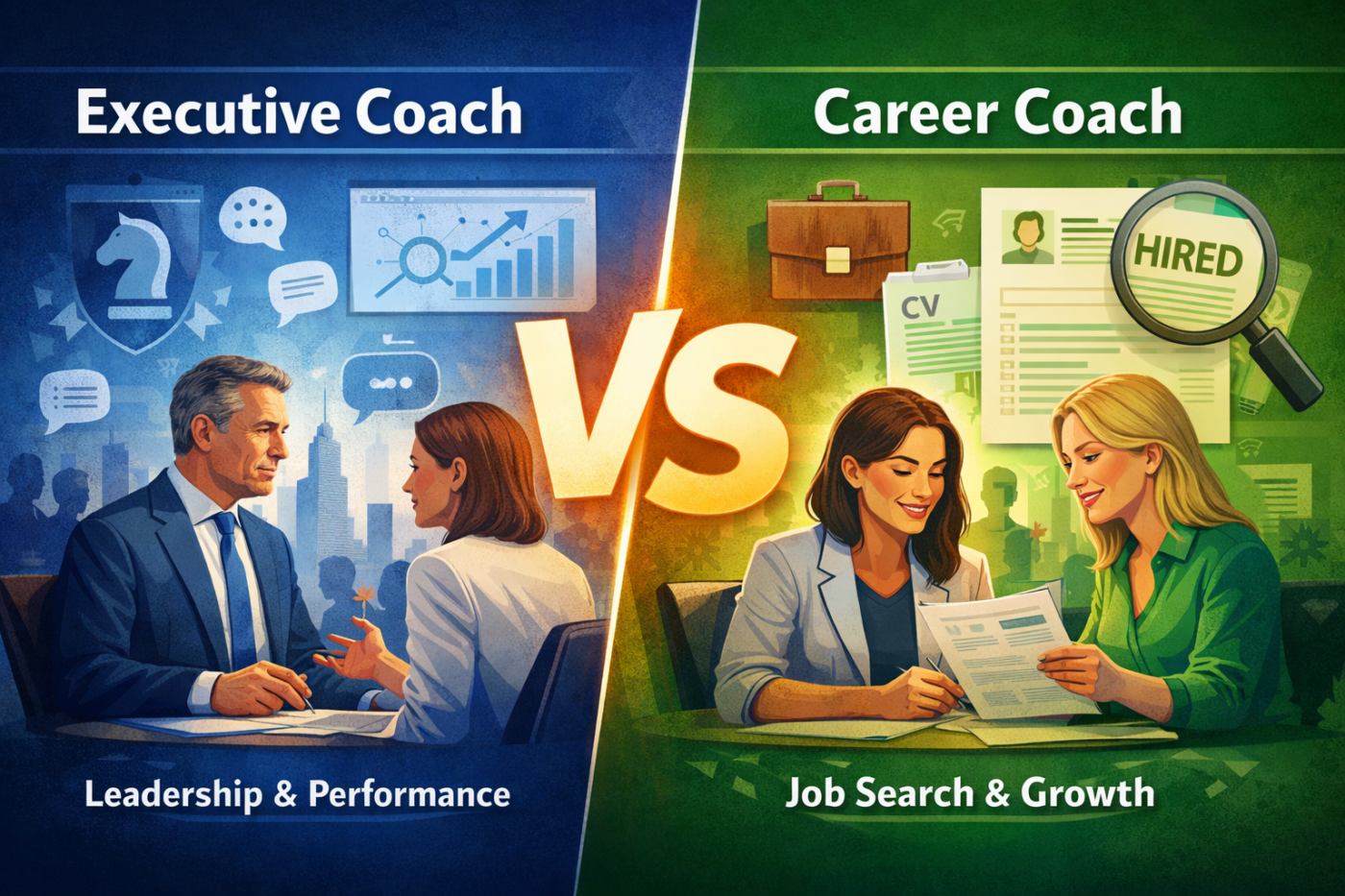
Understanding the nuances between these two disciplines is crucial. Here’s a breakdown of the key distinctions:
| Dimension | Executive Coach | Career Coach |
| Primary Focus | In-role effectiveness and leadership impact | Career transitions and market positioning |
| The “Client” | The leader and the organizational system | The individual and the job market |
| Timeframe | Long-term, relationship-based (6-18 months) | Short-term, project-based (1-6 months) |
| Deliverables | Behavioral shifts, influence strategies, 360° feedback analysis | Resumes, cover letters, interview prep, negotiation scripts |
| Metrics of Success | Improved team performance, business results, stakeholder trust | More interviews, better offers, higher compensation, faster promotion |
| Who Pays | Typically the company | Almost always the individual |
The Elephant in the Room: The Rise of AI
The coaching industry, with its $5.34 billion global market size , is ripe for disruption. The ICF’s own data shows that a majority of coaches are looking to technology to scale their impact. This is where the conversation gets interesting.
For the high-stakes, deeply personal work of executive coaching, a human will always be essential. But for the more data-driven, process-oriented work of career coaching, AI is not just a viable alternative—it’s a superior one.
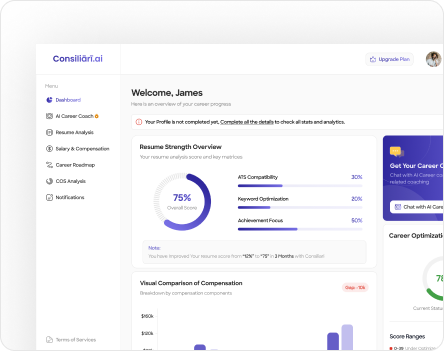
This is the space that Consiliari AI was built to dominate. We’re not trying to replace the trusted advisor who helps a CEO navigate a hostile takeover. We’re here to democratize access to the strategic career intelligence that has, until now, been the exclusive domain of the C-suite. Consiliari provides a data-driven, always-on career management platform that gives you the tools to build your own roadmap, benchmark your salary, and negotiate with the confidence that comes from knowing your true market value.
In the end, the choice is yours. You can continue to play the game with a generic rulebook, or you can arm yourself with the right strategy for the right challenge. The future of your career depends on it.