What To Do When You’ve Been Laid Off

You can be great at your job and still get laid off. That’s the first reality to hold onto, because your brain will try to turn this into a story about your worth. Don’t let it.
The second reality: it still hurts. Even if you saw it coming. Even if you hated the job. Even if you’re “fine.” Your nervous system reads it as rejection and threat. So if you feel foggy, angry, embarrassed, or panicky—normal.
What you need right now isn’t motivation. You need a plan that prevents you from making this worse and gets you back into motion fast.
This post is that plan.
Step zero: don’t sabotage yourself in the first 24 hours
Layoffs create a weird trap: you’re emotional and you’re making legal/financial decisions. That combo produces bad choices.
Here’s what “making it worse” usually looks like:
- You send an angry message (or a “polite” message that’s obviously angry).
- You sign paperwork quickly because you want it to be over.
- You post something on LinkedIn that reads like a subtweet at your old employer.
- You disappear for two weeks, then try to sprint with zero structure.
- You apply to everything because doing “something” feels better than thinking.
If you do nothing else today: don’t do those things. Stay calm and play for the long game.
The first 60 minutes: get clarity while you still can
If you’re in the layoff conversation (or you just got out of it), your mission is simple: leave with facts. Not feelings. Facts.
Ask these questions, and don’t apologize for asking them. You’re not being difficult. You’re being responsible.
What to confirm immediately
- What is my official separation date?
- Am I being paid through that date?
- What severance am I receiving, and when is it paid?
- Is severance a lump sum or payroll continuation?
- What happens to my bonus/commission?
- Will unused PTO be paid out?
- When do benefits end?
- What are my health insurance options (COBRA, extension, etc.)?
- What happens to my equity/RSUs/options? What are the deadlines?
- Am I eligible for rehire?
- Who is my HR point of contact for follow-up?
Then say this sentence: “Please send me everything in writing.”
If they won’t answer on the spot, fine. Just get the name and email of the person who will.
And one more thing: do not sign anything immediately. If you’re being asked to sign a release, you are being asked to give up rights. That’s not inherently bad, but it’s not something you do while you’re still in shock.
The first 48 hours: secure your assets (without doing anything stupid)
A layoff often comes with access getting cut fast. So you need to secure what you’re allowed to keep and document what you can’t.
1) Capture your “proof of value” while your memory is fresh
Open a doc and write, in plain language:
- The biggest outcomes you produced (revenue, cost savings, growth, efficiency, retention, risk reduction).
- The scale (budget, team size, scope, regions, product lines).
- Your “signature work” (what you’re known for).
- 8–10 specific stories you can use in interviews.
You’re not writing a resume yet. You’re capturing raw material so you don’t forget it.
2) Keep work samples only if they’re legitimately yours
Do not take proprietary data, customer lists, internal strategy decks, or anything you wouldn’t feel comfortable explaining in court. Don’t be that person. It will blow up your reputation and can create real legal trouble.
But you can often keep:
- Public-facing assets you created
- Personal performance reviews
- Work you already published publicly (blogs, webinars, talks)
- Your own writing samples that contain no confidential information
When in doubt: leave it.
3) Secure references now, while people still remember your work
The biggest mistake: waiting until you “need” references. By then, months have passed and people are busy.
Text or email 3–5 people you trust and ask for two things:
- permission to use them as a reference
- a short written recommendation on LinkedIn (if appropriate)
You want this while the layoff is recent and your work is top of mind.
4) File for unemployment immediately
Don’t “wait to see.” Don’t “feel weird.” This is what it’s for. The system can be slow, and delays cost you money and runway.
Week one: financial triage (no drama, just math)
Panic comes from uncertainty. Clarity comes from numbers.
Build a simple runway snapshot. One page. Not a spreadsheet masterpiece. Just enough to see the truth.
Your runway snapshot
- Cash on hand (checking + savings you can actually use)
- Severance total and payout timing
- Monthly essentials (housing, food, utilities, insurance, minimum debt payments)
- Discretionary spend (everything else)
- Any income you can reasonably expect (unemployment, freelance, partner support)
Then do two passes:
Pass 1: stop the bleeding (same day)
Cancel or pause anything you don’t need to survive. Don’t negotiate with yourself. Survival first.
Pass 2: lower fixed costs (within 7 days)
This is where runway actually changes.
- Call your insurance and ask for a cheaper plan.
- Call your phone/internet provider and negotiate.
- If you have debt, call and ask about hardship options or reduced APR.
- If housing is crushing you, explore options early (roommate, short-term sublet, refinance, renegotiate). Even if you don’t act, knowing your options reduces panic.
Health insurance deserves a special note: don’t pick based on fear, and don’t ignore risk. If you have ongoing medical needs, cheaping out can cost you more later. Make a deliberate decision: COBRA vs marketplace vs spouse/partner plan, based on numbers and coverage.
The emotional part: you’re allowed to be human, but you can’t be passive
Here’s the honest truth: you’re going to have waves. Some days you’ll feel energized and free. Then a random Tuesday at 2pm you’ll feel embarrassed and angry again.
The goal isn’t to “feel great.” The goal is to stay functional.
Two rules that keep people sane:
- You’re allowed to feel it.
- You’re not allowed to let it run your calendar.
If you want a simple structure that works:
- Sleep like it matters (it does).
- Move your body daily (walks count).
- Limit doom-scrolling and layoff content consumption.
- Talk to one real person every day (not a comment section).
You don’t need a perfect mindset. You need a rhythm.
Week two: decide what you’re actually selling (most people skip this)
“Open to opportunities” sounds flexible. It’s actually weak positioning.
You need a target. You can change it later, but you need one now.
Pick:
- One primary role you are going after.
- One secondary role you’d accept.
- One pivot option only if it’s real (not fantasy).
Then define your non-negotiables:
- pay floor (a number)
- location/remote expectations
- level/title range
- industries you will/won’t do
- dealbreakers (travel, hours, comp structure, management style)
This matters because everything that follows—resume, LinkedIn, outreach—only works when it’s aligned to a clear target.
Week two: fix your story (one sentence, calm and credible)
You need a layoff explanation that’s honest, short, and boring.
Boring is good. Boring signals stability.
Here’s a template:
Layoff story template
“I was impacted by a company-wide restructuring. My results were strong, and I’m focused on roles where I can [do the work you do best] and drive [the outcome you’re known for].”
That’s it.
What not to do:
- Don’t trash leadership.
- Don’t explain office politics.
- Don’t over-defend yourself.
- Don’t sound like you want sympathy.
Your story should make the layoff feel like a footnote, not the main plot.
Week two to three: rebuild your assets the right way
This is where people waste time. They “update” their resume and LinkedIn without positioning, so it reads like a biography instead of a pitch.
Your resume’s job isn’t to describe you.
Your resume’s job is to get you interviews for a specific role.
A strong resume:
- leads with outcomes, not responsibilities
- speaks the language of the target job description
- makes your scope obvious (team, budget, scale)
- shows progression or credibility indicators (promotions, awards, high-impact projects)
Your LinkedIn’s job isn’t to look nice.
Your LinkedIn’s job is to start conversations.
A strong LinkedIn:
- headline that says what you do and the outcome you drive
- “About” section that reads like a confident introduction, not a life story
- featured section with proof (case studies, talks, writing, portfolio)
You should also build one simple proof asset
If you don’t have a portfolio, create a one-page case study. One.
Format:
- The situation (context)
- The problem (what was broken)
- The action (what you did)
- The result (numbers)
- The lesson (how you think)
This is especially powerful in interviews. It turns you from “person who needs a job” into “person who solves problems.”
Build a job search system (because willpower is unreliable)
Treat your job search like a sales pipeline. You are selling your ability to produce outcomes.
Here’s what actually works: a weekly cadence with measurable inputs.
A realistic weekly cadence might look like this:
- 10 warm outreaches (people who can introduce you)
- 5 recruiter conversations
- 8–12 high-fit applications (not spam)
- 2 interview loops active at any time
And a daily rhythm:
- 60–90 minutes outreach and follow-ups
- 60 minutes applications (high fit only)
- 60 minutes interview prep / skill gap / portfolio
That’s not glamorous. It is effective.
Outreach scripts that get replies (copy/paste and adapt)
Outreach works when it’s specific, respectful, and easy to respond to. Most people send vague messages that force the other person to do work.
Don’t do that.
1) Warm contact (someone you know)
Subject: Quick ask (15 min)
Hi [Name] — quick update: I was impacted by a restructuring at [Company]. I’m moving fast on my next role and targeting [Role] positions where I can drive [Outcome].
You came to mind because of your work in/with [Industry/Company type]. Would you be open to a 15-minute call this week so I can sanity-check my target list and see where I should focus?
If it’s easier, I can send 5–7 companies and you can tell me which ones are worth pursuing.
Thanks,
[Your Name]
Why it works: it’s short, specific, and the ask is clear.
2) “Can you introduce me?” (direct but polite)
Hi [Name] — I noticed you’re connected with [Hiring Manager / Person] at [Company]. I’m exploring [Role] roles and [Company] is on my short list because [specific reason].
Would you feel comfortable introducing me? If yes, here’s a 2-sentence blurb you can use:
“[Your Name] led [1-line credibility] and is targeting [Role] roles. They’re strong in [2 skills] and have delivered [1 measurable result]. Thought you two should connect.”
No worries at all if you’d rather not — I appreciate you either way.
3) Recruiter message (tight and useful)
Hi [Recruiter Name] — I’m a [Role] with [X years] in [domain] and a track record of [outcome + metric]. I was impacted by a restructuring and I’m actively targeting [Role] roles in [locations/remote] with comp around [$X–$Y].
If you’re working on anything in that range, I’d love to connect. Happy to send a resume and a quick snapshot of wins.
Best,
[Name]
4) Hiring manager cold message (problem-first)
Hi [Name] — I’m reaching out because I’ve been following [Company/team] and noticed you’re hiring for [Role]. I’ve led [relevant work] and delivered [specific result].
If helpful, I can share a 30/60/90 approach for how I’d tackle [key responsibility] in this role. Either way, I’d love to be considered.
— [Name]
5) LinkedIn post (honest, not cringe)
Today I was impacted by a company restructuring at [Company]. I’m proud of the work I did there, especially [one specific outcome].
I’m now focused on [Role] roles where I can help teams drive [outcome]. If you know of teams hiring in [location/remote], I’d appreciate a connection.
If helpful, here are a few areas I’m strongest in: [3 bullets max].
Thank you to everyone who’s reached out — I’m moving quickly and staying optimistic.
(Yes, this is slightly formulaic. That’s fine. The goal is to activate your network without sounding bitter.)
Interview answers you can use immediately
Interviewing after a layoff isn’t complicated. It’s emotional. If you stay calm and prove value, you’ll be fine.
Here are strong, natural answers to the questions you will get.
1) “What happened at your last job?”
Answer:
“I was impacted by a restructuring. It wasn’t performance-related. I’m proud of what I delivered there—specifically [one result]. Now I’m focused on roles where I can apply that same skill set to [target outcome].”
Stop talking. Don’t over-explain.
2) “Tell me about yourself.”
Most people ramble. Don’t.
Answer (simple 30-second structure):
“I’m a [role] who focuses on [core specialty]. Over the last [timeframe], I’ve worked across [context] and my work usually shows up as [2–3 outcomes]. Most recently at [Company], I [one-line win]. Now I’m looking for a role where I can [what you want to do next] at a team that cares about [your value filter].”
3) “Why do you want this role / this company?”
Answer:
“I’m targeting roles where I can drive [outcome], and this role is clearly scoped around that. What stands out to me about your team is [specific thing: product direction, market, leadership, customer]. I’m confident I can contribute quickly because I’ve solved similar problems—like [example].”
This answer works because it’s not flattery. It’s alignment.
4) “What’s your biggest strength?”
Pick a strength that’s useful for the role and prove it.
Answer:
“My biggest strength is [skill], specifically in high-pressure environments. For example, at [Company], we had [problem], and I [action]. The result was [metric]. I’m strong at repeating that pattern: diagnose fast, prioritize, execute, measure.”
5) “What’s a weakness?”
Don’t confess a fatal flaw. Don’t say “I work too hard.” Give a real weakness with a fix.
Answer:
“I can sometimes move too fast when I’m confident about a direction. I’ve learned to slow down at the start and align stakeholders early. Now I use a simple habit: I write a one-page plan, confirm success metrics, and get explicit buy-in before I sprint.”
6) “Walk me through a difficult situation with a colleague.”
Answer:
“In one role, I partnered with a stakeholder who had a very different approach. The friction was [what]. I set a short meeting to align on outcomes and constraints, then we agreed on a shared metric and decision rules. The relationship improved because we stopped arguing opinions and started working the same scoreboard.”
Key: you don’t sound like a victim. You sound like a leader.
7) “What salary are you looking for?”
Give a range, anchor to market and value, and stay calm.
Answer:
“Based on the scope of the role and market ranges I’ve seen, I’m targeting $X to $Y in base, depending on total package and level. I’m flexible for the right fit, but I want to be in a range that matches the impact expected.”
If they push for a number first, repeat it calmly. Don’t negotiate against yourself.
8) “Why should we hire you?”
Answer:
“You should hire me if you want someone who can [core outcome], without needing months to ramp. I’ve done it in [similar context], I know how to measure success, and I’m comfortable owning results. If the goal is [key KPI], I can help you move it.”
Direct. No begging.
The leverage move most people skip: get a coach
A layoff is a moment where your brain lies to you. It tells you you’re behind, you’re damaged, you should accept anything, you should hide.
A coach—human or AI—stops that spiral and turns this into execution.
A good coach is not a cheerleader. A good coach:
- forces clarity on your target role and positioning
- tightens your story so you don’t ramble or apologize
- helps you build a pipeline that converts to interviews
- drills interviews so you’re sharp even on low-energy days
- keeps you moving when motivation drops
If you can afford a human coach, great—use them for high-stakes moments: final rounds, leadership narrative, negotiation.
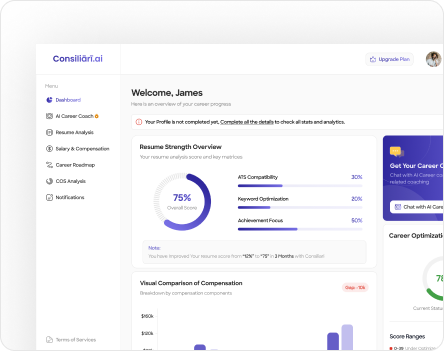
For most people, an AI coach is the highest ROI option because it’s always available and structured. You can use Consiliari AI as your day-to-day operating system: build your positioning, generate role-specific resumes and outreach scripts, track your pipeline, and prep for interviews without doing everything from scratch every time.
The real point isn’t “coaching.” The point is speed + accountability. That’s what shortens your time-to-offer.
A simple 30-day plan (what to do each week)
Week 1: stabilize
You’re not “job searching” yet. You’re securing runway and preventing mistakes.
- Lock facts: severance, benefits, equity deadlines
- File unemployment
- Build runway snapshot
- Secure references
- Write your raw “proof of value” doc
Week 2: position
Now you choose your target and build assets that match it.
- Pick primary role + company list
- Write your one-sentence story
- Rebuild resume + LinkedIn aligned to target
- Create one proof asset (case study)
Week 3: pipeline
This is where momentum starts.
- Outreach daily
- Recruiter conversations
- High-fit applications only
- Interview prep begins before interviews arrive
Week 4: close
You get sharper, you iterate, you negotiate.
- Tighten messaging based on responses
- Drill interviews
- Build a simple negotiation plan (minimums + levers)
- Keep pipeline full even when interviews start (so you don’t get desperate)
Special situations (quick but important)
If you’re on a visa: move fast and get professional guidance. Your timeline is different. Your job search must be more targeted and less “wait and see.”
If you’re senior/executive: narrative control matters. You need tighter positioning, more discreet outreach, and a clear “why now” story that signals leadership stability.
If you’ve been laid off twice: don’t over-defend. Treat it like market volatility, keep the story short, then drown them in proof: outcomes, scope, judgment.
What to do today (seriously, today)
Do these three things before you research anything else:
- Write your one-sentence layoff story.
- Message five people for warm intros using the script above.
- Build your runway snapshot (even if it’s messy).
That’s how you turn a layoff from a crisis into a pivot.
If you want, paste your target role and a link to one job description you want, and I’ll write:
- a tailored one-sentence positioning statement,
- a recruiter message that matches the role,
- and a tight “Tell me about yourself” answer that sounds like you on a good day.