Aptitune.App vs. Consiliārī AI
AI career coaching is exploding — but most tools still fall into one of two buckets:
- A chatbot that feels helpful but doesn’t change your trajectory
- A structured system that turns career growth into execution
If you’re deciding between Consiliārī AI and Aptitune.App, this comparison will help you make the right choice based on what you actually need: clarity, better positioning, higher income, better opportunities, or all of the above.
We’ll break down both platforms objectively across strategy, assessments, coaching depth, pricing models, and who each tool is best for.
Quick verdict: the core difference in 1 sentence
- Consiliārī AI is built as a career optimization system (score → roadmap → salary strategy → execution loop).
- Aptitune.App is built as a guided career journey platform (pathways → modules → personality insights → coaching).
Both can be useful. But they produce very different outcomes depending on what stage you’re in.
What are these platforms, really?
What Consiliārī AI is
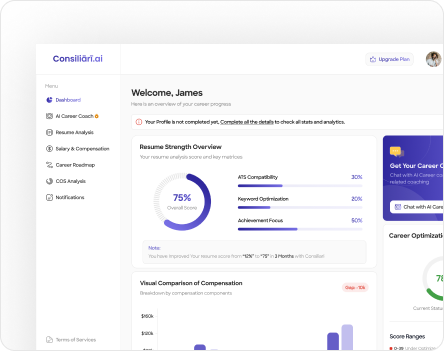
Consiliārī positions itself as a lifelong AI career strategist that helps professionals improve career health across multiple dimensions — including market readiness, growth trajectory, positioning, and compensation.
Its defining feature is the Career Optimization Score (COS) — a 0–100 metric meant to function like a “credit score for your career.”
From there, it generates guidance such as:
- career roadmaps
- goal structures
- salary intelligence
- negotiation prep
The product is designed around continuous improvement — not a one-time quiz.
What Aptitune.App is
Aptitune.App positions itself as an AI “Principal Coach” centered around structured pathways (assessment journeys) and coaching modules.
Instead of “score + roadmap,” Aptitune organizes career development into guided programs such as:
- Comprehensive Career Assessment
- Job Transition
- Entrepreneurial Development
- High Potential Development
- Career Orientation
A defining element is its built-in emphasis on Big Five personality assessment, alongside guided modules and token-based usage.
Consiliārī vs Aptitune: Feature-by-feature comparison
Let’s get into the real stuff.
1) Coaching model: execution coach vs guided module coach
Consiliārī AI
Consiliārī leans into always-on coaching and execution loops. You’re not meant to “finish” the tool — you use it continuously like a career cockpit.
Paid plan positioning includes unlimited AI coaching and deeper roadmap + salary tools.
Best for: professionals who want continuous strategy support, not just reflection.
Aptitune.App
Aptitune’s coaching flows through modules. You pick a pathway, complete steps, and the AI synthesizes learnings into tailored guidance.
You can also use the coach directly, but it’s optimized for structured progression.
Best for: professionals who need structured prompts and guided reflection to build clarity.
2) Assessments: measurable career score vs personality-driven insight
Consiliārī: Career Optimization Score (COS)
COS is central and designed to be repeatable — you’re supposed to improve it over time.
Consiliārī states COS is:
- 0–100
- based on multiple weighted factors
- covering several career readiness pillars
This creates a very specific advantage: you can measure progress, not just feel better after a coaching session.
Aptitune: Big Five + pathway diagnostics
Aptitune emphasizes a Big Five personality test (120 questions / ~30 minutes) with AI analysis.
This supports deeper self-understanding (communication style, motivation, decision-making), which is valuable — particularly if your challenge is internal clarity rather than external positioning.
3) Salary & negotiation: one platform clearly specializes here
This is where the gap becomes real.
Consiliārī AI
Salary and negotiation are explicitly positioned as core product value, with paid plan messaging that includes salary insights and negotiation support.
If what you really want is:
- compensation benchmarking
- negotiation scripts
- compensation strategy
- “how do I get paid more for my value?”
Consiliārī is clearly designed for that.
Aptitune.App
Aptitune is not marketed as a salary-first tool. Its public materials emphasize pathways, coaching, quizzes, and simulations — but compensation optimization is not foregrounded as a key system.
This doesn’t mean Aptitune can’t help with negotiation conversations — but it’s not built around that as a differentiator.
4) Structure: open roadmap vs pre-built programs
Consiliārī AI
It’s a dynamic roadmap approach:
- score → diagnosis → tailored roadmap
- continuous coaching reinforcement
- goal tracking narrative
This is best for high performers who hate being boxed into cookie-cutter training plans.
Aptitune.App
Aptitune’s “pathways” feel closer to career development programs than to a self-directed career OS.
For example, it publicly lists pathway scope like:
- Comprehensive assessment: 19 modules (~9 hours)
- Job transition: 10 modules (~5 hours)
This is great for beginners and switchers who need structure.
Pricing model: unlimited coaching vs token-based usage
Consiliārī pricing
Consiliārī keeps pricing simple:
- Free plan
- Paid plan (“Career Optimizer”) at $25/mo or $195/yr
The real value: predictable pricing and “unlimited coaching” positioning.
Aptitune pricing
Aptitune uses a token model:
- Free: 50k tokens/month
- Paid tiers scale up to 250k / 1M / 2.5M tokens per month
They explain token math publicly (1,000 tokens ≈ 750 words, input + output).
Token model upside: flexibility, low entry cost
Token model downside: power users hit ceilings when they need intense support (job search sprints)
Trust, transparency, and AI limitations
Both products make strong claims — but smart users should treat them correctly.
Consiliārī
Consiliārī communicates security positioning (no ads/trackers messaging on pricing, user control over data).
It also includes performance statements around COS (vendor claims).
Aptitune
Aptitune’s documentation is refreshingly direct: they state AI is not 100% reliable and recommend personal judgment.
They also acknowledge use of OpenAI’s API in their terms.
Who should use which platform?
This is the section most comparison articles get wrong — because they assume all users are the same.
Consiliārī AI is built for:
✅ Ambitious professionals at an inflection point
✅ People who want to optimize income, positioning, and trajectory
✅ Career builders who want a system (score + roadmap + execution)
✅ Professionals who value measurable improvement over generic advice
You choose Consiliārī when:
You want to grow faster, earn more, and make career strategy a weekly habit.
Aptitune.App is built for:
✅ People who want structured guidance, like a career curriculum
✅ Switchers, explorers, early-career professionals
✅ Users who love assessments and personality frameworks
✅ People who want low price entry and controlled usage through tokens
You choose Aptitune when:
You need clarity, self-awareness, and guided modules to find direction.
Final recommendation (neutral but honest)
If your objective is career acceleration, Consiliārī is better aligned.
Because career growth isn’t about insight. It’s about execution — and execution improves when you have:
- a measurable score
- a roadmap tied to market reality
- coaching that doesn’t stop after one session
- compensation strategy baked into the system
If your objective is self-discovery and structured exploration, Aptitune is a strong contender with an unusually clear token model and pathway design.
Want the best of both?
A realistic approach many smart professionals will take:
- Use Aptitune to clarify direction (if you’re confused or switching)
- Use Consiliārī to optimize trajectory + earnings once direction is clear
Sources
Consiliārī pages: COS definition and factors, pricing features including coaching/salary.
Aptitune pages: Pathways/modules, pricing tokens, Big Five assessment, limitations & terms.